
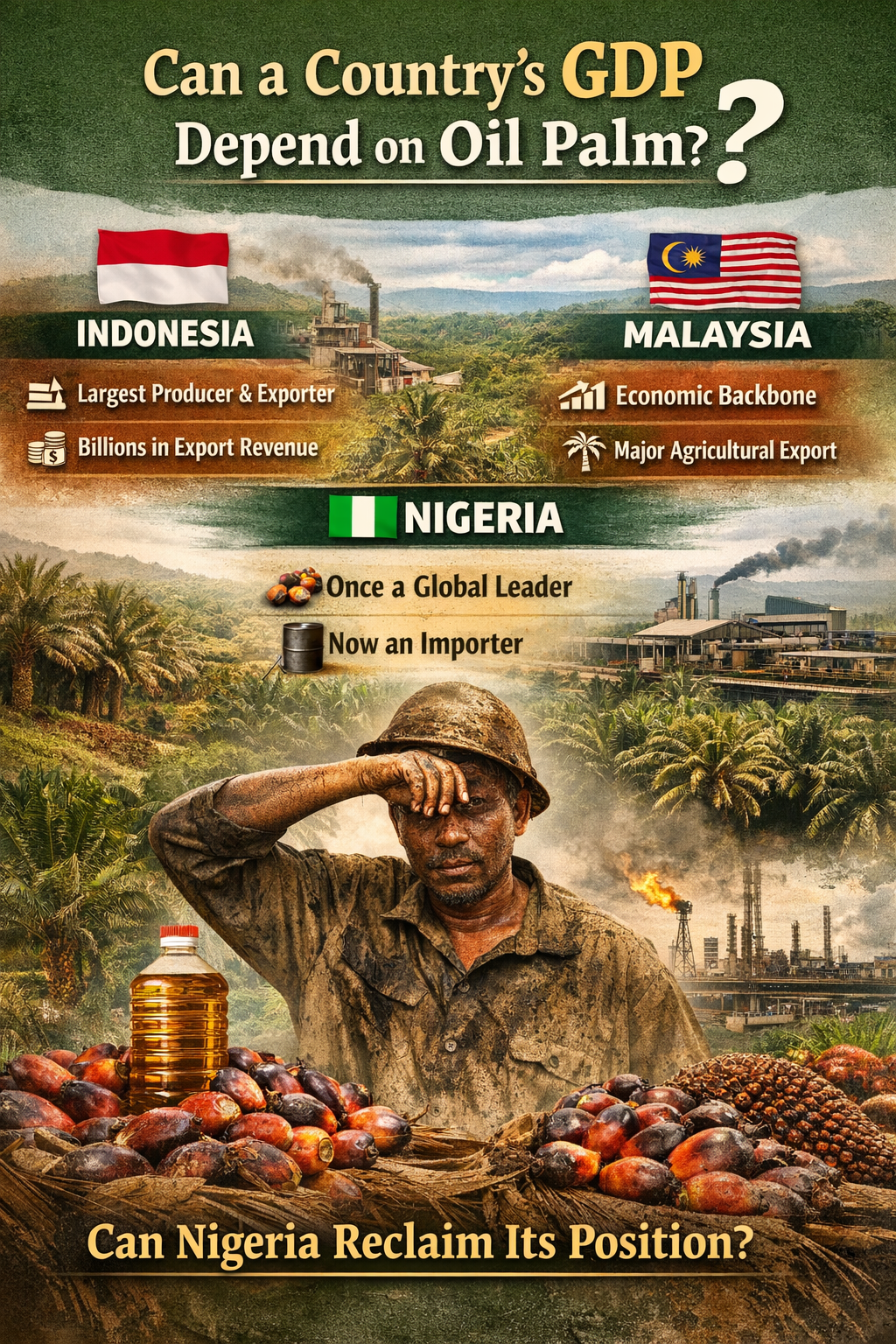
The honest answer is this: no major economy relies entirely on oil palm alone. However, there are countries where palm oil plays such a significant role in exports, employment, and foreign exchange earnings that it directly influences national economic performance. Indonesia is the world’s largest producer and exporter of palm oil. The sector generates billions of dollars annually and supports millions of jobs across cultivation, processing, logistics, and export operations. While Indonesia’s economy is diversified across mining, manufacturing, and services, palm oil remains one of its most strategic agricultural commodities and a major contributor to foreign exchange earnings.
Malaysia presents a similar story. As the second-largest global producer, palm oil has historically been a backbone of its agricultural economy.
The industry contributes meaningfully to agricultural GDP, export revenue, and rural development. Over the decades, Malaysia invested heavily in research, improved seedlings, mechanized processing, and structured value chains — transforming palm oil into a globally competitive industry. Then there is Nigeria. Interestingly, Nigeria was once one of the world’s leading producers of palm oil in the 1960s. Today, however, the country imports large quantities annually to meet domestic demand. While palm oil contributes to agricultural output, it no longer holds the dominant economic position it once did. Instead, Nigeria’s GDP relies heavily on crude petroleum exports. This contrast raises an important strategic question: if countries like Indonesia and Malaysia built strong economic pillars around oil palm through structured investment and policy support, what is stopping Nigeria from reclaiming its position?
As you move toward the midpoint of the article, this paragraph provides an opportunity to connect earlier ideas with new insights. Use this space to present alternative perspectives or address potential questions readers might have. Strike a balance between depth and readability, ensuring the information remains digestible. This section can also serve as a transition to the closing points, maintaining momentum as you steer the discussion to its final stages.
Palm oil is not just an agricultural product. It feeds into food manufacturing, cosmetics, pharmaceuticals, detergents, bioenergy, and industrial applications. It is embedded in global supply chains. Where production is efficient and scalable, it becomes a powerful driver of rural employment, export revenue, and industrial growth. No country’s GDP depends solely on oil palm. But in the right environment — with strong management, processing capacity, and market access — palm oil can become a significant economic stabilizer and growth engine. For countries with the right climate and land resources, the opportunity is not theoretical. It has already been proven. The real question is who is ready to position for the next phase of agricultural value creation.